- 在神經網路中,每個神經層都通過以下的方式進行資料轉換
output = relu(dot(W, input) + b) W和b為該層的屬性張量,統稱為該層的權重(weights) 或可訓練參數(trainable parameters),分別為 內核(kernel) 屬性和 偏值(bias) 屬性。- 我們的目標是要透過訓練(training) 來進行權重的微調,進而得到最小的損失值。
- 參數調大或調小,可能會對應到「損失值變大」或「損失值變小」兩種可能(如果兩者皆變小,稱為 saddle point,兩者皆變大,可能為 local minium)。
但如果透過兩個方向的正向傳播來檢查微調的方向,效率很低,於是科學家引入了梯度下降法。
梯度下降法(gradient descent)
- 張量運算的導數稱為梯度(gradient)。
- 純量函數的導數相當於在函數曲線上找某一點的斜率。
- 張量函數上求梯度,相當於在函數描繪的多維曲面上求曲率。
y_pred = dot(W, x)
loss_value = loss(y_pred, y_true)
假設只考慮 W 為變數,我們可以將 loss_value 視為 W 的函數。
loss_value = loss(dot(W, x), y_true) = f(W)假設 W 的當前值為 W0,那麼函數 f 在 W0 這點的導數就是
f'(W)=\frac{d\text{(loss\\_value)}}{d\text{W}}|\text{W}_0我們將上式寫成
g = grad(loss_value, W0)代表了在 W0 附近,loss_value = f(W) 的梯度最陡方向之張量,我們可以透過往往「斜率反方向」移動來降低 f(W)。
if g > 0:
    W' = W0 - dW
elif: g < 0:
    W' = W0 + dW
我們將 g 直接代入式子,並引入 (eta) 的概念,可以想成是每次移動的步伐大小。
W' = W0 - g * eta- 藉由不斷迭代,直到最後平緩,代表移到動 local minimum。但這個 local minimum 不一定是 global minimum,所以後面會加入其它方法來避免被 trap 在 local minimum。
- 以下是李宏毅老師的圖解,我覺得很生動,可以幫助理解。
圖解
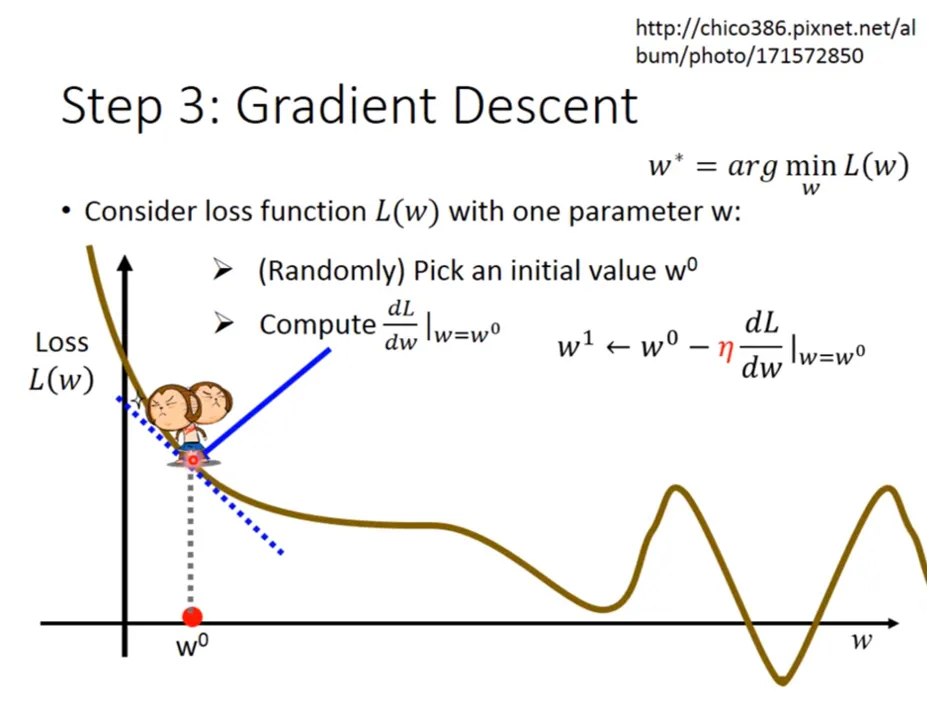
隨機梯度下降
-
從上述的推導,其實我們可以設想,如何快速取得最小的損失值,方法是找出所有導數為 0 的點,再對這些點進行檢查,便可求出 global minimum。
-
然後對實際的神經網路而言,參數不會只有 2~3 個,可能會有上千萬個,故要求這樣的方程式解並非容易的事。
-
於是我們可以透過 小批次隨機梯度下降(mini-batch stochastic gradient descent, mini-batch SGD) 來進行
- 取出一批次的訓練樣本 x 和對應的目標 y_true(也是標籤(label))
- 以 x 為輸出資料,運行神經網路獲得預測值 y_pred。此步驟稱為正向傳播(forward pass)
- 計算神經網路的批次損失值。
- 計算損失值相對於神經網路權重的梯度。
- 將參數稍微向梯度的反方向移動,從而降低一些批次損失值。此步驟稱為反向傳播(back propagation)
其中 $\eta$ 為**學習率(learning rate)**,為純量因子,可用來調整梯度下降的速度。 + 學習率太大太小都可能產生問題 + 學習率太大可能會略過真正的最小值 + 學習率太小可能會困在區域最小值 -
批次的量(batch size)
- 一次將所有的資料全用上,稱為整批 SGD(batch gradient descent),好處是每次參數值更新會更準確,但是也會提升時間複雜度。
- 為了在「準確度」與「複雜度」取一個 tradeoff,通常會使用合理大小的小批次資料進行計算。
-
SGD 的變體
- 在計算下一次權重的更新量,可以考慮先前的取重更新量來做調整,而非僅僅根據梯度的當前值。常見的變體包含:
- momemtum
past_velocity = 0. momemtum = 0.1 # 固定的動量因數 while loss > 0.01: w, loss, gradient = get_current_parameters() velocity = past_velocity * momemtum - learning_rate * gradient w = w + momemtum * velocity - learning_rate * gradient past_velocity = velocity update_parameter(w)- Adagrad
- RMSProp
- 在計算下一次權重的更新量,可以考慮先前的取重更新量來做調整,而非僅僅根據梯度的當前值。常見的變體包含:
反向傳播演算法(Backpropagation)
前面介紹的函數是簡單函式,可以很簡單地算出導數(梯度),但在實際情況下,我們需要能夠處理複雜函數的梯度。
連鎖律(Chain Rule)
反向傳播是借助簡單運算(eg. 加法、relu或是張量積)的導數,進而得出這算簡單運算的複雜組合的梯度。
舉例而言,如下圖,我們使用了兩個密集層做轉換,
我們可以把函式表運成:
y1 = relu(dot(W1, X)+b1)
y2 = softmax(dot(W2, y1)+b2)
loss_value = loss(y_true, y2)
或
loss_value = loss(y_true, softmax(dot(W2, relu(dot(W1, X)+b1))+b2))我們可以透過連鎖律求得連鎖函數的導數:假設有 , 兩個函數,它們的複合函數 有著 的特性。
def fg(x):
    x1 = g(x)
    y = f(x1)
    return y
根據連鎖律
換言之,我們只需要求出 就可以知道找出複合函數 的導數了。
詳述
前向傳播
對於一個神經元,輸入值 通過權重 和偏置 進行線性組合,然後通過激活函數 :
損失函數
假設使用均方誤差(MSE)作為損失函數:
反向傳播
使用連鎖律計算損失函數對權重的偏導數:
分解每一項:
因此:
權重更新
使用梯度下降更新權重:
- 思考正向傳播時,我們計算的順序是
- 而在推導梯度時,我們計算的順序是,剛好是反向過來計算的,故這個過程稱作「反向傳播」
如今我們在現代框架中,已經可以透過自動微分來實作神經網路,如 TensorFlow 的 Gradient Tape。故我們可以只專注在「正向傳播」的過程。
TensorFlow 的 Gradient Tape
透過 TensorFlow 的 Gradient Tape 函式,可以快速的取得微分值:
- 其中
tf.Variable是一個變數物件,它可以是任意階的張量
範例:
import tensorflow as tf
x = tf.Variable(0.)
with tf.GradientTape() as tape:
  y = 2 * x + 3

grad = tape.gradient(y, x)
grad

>>> <tf.Tensor: shape=(), dtype=float32, numpy=2.0>
實作一個簡單的模型
Dense Layer
- 作用是將 input 與 W 做點積,與 b 相加,再輸入激活函數 f
- 相當於
y = f(wx+b)
import tensorflow as tf

class NaiveDense:
  def __init__(self, input_size, output_size, activation):
    self.activation = activation
    w_shape = (input_size, output_size)
    w_initial_value = tf.random.uniform(w_shape, minval = 0, maxval = 0.1)
    self.W = tf.Variable(w_initial_value)
    b_shape = (output_size, )
    b_initial_value = tf.zeros(b_shape)
    self.b = tf.Variable(b_initial_value)

  def __call__(self, inputs):
    return self.activation(tf.matmul(inputs, self.W) + self.b)

  @property
  def weights(self):
    return [self.W, self.b]
Sequential
- Sequential 用來定義層與層之間連接的方式
- 在次簡單的用「依序」的方式進行正向傳播
class NaiveSequential:
  def __init__(self, layers):
    self.layers = layers

  def __call__(self, inputs):
    x = inputs
    for layer in self.layers:
      x = layer(x)
    return x

  @property
  def weights(self):
    weights = []
    for layer in self.layers:
      weights += layer.weights
    return weights
Build Model
- 通過上面兩個實作,便可以簡單建立一個 Keras 雙層模型:
model = NaiveSequential([
    NaiveDense(input_size=28*28, output_size=512, activation=tf.nn.relu),
    NaiveDense(input_size=512, output_size=10, activation=tf.nn.softmax)
])
Batch Generator
- 我們需要用「小批次」的方式來迭代,能更有效率的訓練資料:
import math
class BatchGeneartor:
  def __init__(self, images, labels, batch_size=128):
    assert len(images) == len(labels)
    self.index = 0
    self.images = images
    self.labels = labels
    self.batch_size = batch_size
    self.num_batches = math.ceil(len(images) / batch_size)

  def next(self):
    images = self.images[self.index : self.index + self.batch_size]
    labels = self.labels[self.index : self.index + self.batch_size]
    self.index += self.batch_size
    return images, labels
Update Weights
- 接下來我要透過 來更新 W:
def update_weights(gradients, weights, learning_rate=1e-3):
  for g, w in zip(gradients, weights):
w.assign_sub(g * learning_rate)- 事實上我們不會這樣更新權重,我們可以借用 keras 的 optimizers
from tensorflow.keras import optimizers
optimizer = optimizers.SGD(learning_rate=1e-3)
def update_weights(gradients, weights):
  optimizer.apply_gradients(zip(gradients, weights))
Training
- 有了以上的工具,我們就可以進行訓練了
def one_training_step(model, images_batch, labels_batch):
  with tf.GradientTape() as tape:
    # y' = f(wx+b)
    predictions = model(images_batch)
    # loss[] = y' - y_true
    per_sample_losses = (tf.keras.losses.sparse_categorical_crossentropy   (labels_batch, predictions))
    # avg_loss = loss
    average_loss = tf.reduce_mean(per_sample_losses)[] / batch_size
    # g = grad(L, w)
    gradients = tape.gradient(average_loss, model.weights)
    # w' = w-ηg
    update_weights(gradients, model.weights)
return average_loss- fit
def fit(model, images, labels, epochs, batch_size=128):
  for epoch_counter in range(epochs):
    print(f"Epoch {epoch_counter}")
    batch_generator = BatchGeneartor(images, labels)
    for batch_counter in range(batch_generator.num_batches):
      images_batch, labels_batch = batch_generator.next()
      loss = one_training_step(model, images_batch, labels_batch)
      if batch_counter % 100 == 0:
print(f"loss at batch {batch_counter}: {loss:.2f}")- 執行
from tensorflow.keras.datasets import mnist
(train_images, train_labels),(test_images, test_labels) = mnist.load_data()

train_images = train_images.reshape((60000, 28*28))
train_images = train_images.astype("float32") / 255
test_images = test_images.reshape((10000, 28*28))
test_images = test_images.astype("float32") / 255

fit(model, train_images, train_labels, epochs=10, batch_size=128)
Evaluation
- 最後我們再投入 test_images 來評估我們 training 的結果
import numpy as np

predictions = model(test_images)
predictions = predictions.numpy()

predicted_labels = np.argmax(predictions, axis=1)
matches = predicted_labels == test_labels
print(f"accuracy: {matches.mean():.2f}")