基礎篇
1. Layer
- Layer 是神經網路的基本資料處理模組(data-processing module),可以接受一個或多個張量輸入,再輸出一個或多個張量。Layer 的權重可視為該層的狀態(state),在經過隨機梯度下降法(SGD)不斷更新權重(學習),最終得到損失值最低的權重值。
分類
- 不同格式的資料需要不同的層來處理。
- 密集連接層(densely connected layer): 又稱全連接層(fully connected layer)或密集層(dense layer)。如果資料輸入是簡單的 1D 向量資料,則多半是儲存在 2D 張量中,其 shape 為 (樣本 samples, 特徵 features),通常是用
- 循環層(recurrent layer): 如果輸入的資料是 2D 序列(sequence) 資料,多半是儲存在 3D 張量中,其 shape 為 (樣本 samples, 時戳 timestamps, 特徵 features),如 LSTM 層。
- 2D 卷積層: 如果是 3D 影像資料,多半是儲存在 4D 張量中,通常使用 2D 卷積層(Conv2D Layer)
Keras 中的基礎 Layer 類別
- Layer 類別是 Keras 的核心,每個 Keras 元件都是一個 Layer 物件並與 Layer 有密切互動。Layer 是將一些狀態(權重)和運算(正向傳播)包在一起的物件。
- 雖然權重可以在建構子
__init__()中建立,但我們通常會使用build()來建立,然後用call()來執行正向傳播。
from tensorflow import tf

class SimpleDemo(keras.layers.Layer):
    def __init__(self, units, activation=None):
        super().__init__()
        self.units = units
        self.activation = activation

	def build(self, input_shape):
		input_dim = input_shape[-1]
		self.W = self.add_weight(shape=(input_dim, self.units),initializer="random_normal")
		self.b = self.add_weight(shape=(self.units,),initializer="zeros")

	def call(self, inputs):
		y = tf.matmul(inputs, self.W) + self.b
		if self.activation is not None:
			y = self.activation(y)
return y- 我們可以像使用函式一樣來實例化 Layer 物件,其輸入為一個張量
sample_layer = SimpleDemo(units=32, activation=tf.nn.relu)- 建立
build()方法的意義在於,我們希望在第一次呼叫 layer 物件時才即時創建權重張量。 - keras 會幫我們做好自動推論權重的 shape,我們可以把關注給放在如何定義
build()。
model = keras.Sequential([
	SimpleDense(32, activation="relu"),
	SimpleDense(64, activation="relu"),
	SimpleDense(32, activation="relu"),
	SimpleDense(10, activation="softmax")
])- 事實上
__call__()做的是遠不只推論 shape,還有 eager 執行模式 和 graph 執行模式 之的路徑選擇等等。
2. Model
-
深度學習模型是由多個層所組成的結構,在 Keras 是以 Model 類別來建立模型物件。
-
目前為止我們只使用過
Sequential類別的模型(序列式模型),由多個層簡單堆疊而成,有單一的輸入與單一的輸出。 -
有其他常見的神經網路拓撲,如:
- 雙分支神經網路(Two-branch networks): 中間有分支,而非只有線性連接
- 多端口網路(Multihead networks): 有多個輸入端或輸出端
- 殘差連接(Residual connections): 某些層的輸出會分一條分支跳接到較遠的層
-
Keras 有兩種方式來建構這些非線性模型:
- 直接創建 Model 類別的子類別
- 使用函數式 API(functional API)
-
模型的拓撲定義了一個假設空間(hypothesis space),經由回饋訊號的指引,搜尋有用的輸入資料表示法。選擇完模型拓撲後,接著就是要找出可以發揮最好效果的權重張量。
-
為了進行訓練,必須做一些假設,這些假設定義了模型可以學到的東西,所以假設空間的結構(模型架構)就變得格外重要,因為它會對現有問題的假設進行編碼,這些假設就是模型開始學習前的先驗知識(prior knowledge)
3. 編譯
-
在 compile 之前,要先定義三件事情:
- 損失函數(loss function)
- 優化器(optimizer)
- 評量指標
-
使用字串的方式定義優化器、損失函數、評量指標
model = keras.Sequential([keras.layers.Dense(1)])
model.compile(optimizer="rmsprop",
							loss="mean_square_error",
metrics=["accuracy"])- 使用物件實例的方式定義優化器、損失函數、評量指標
model.compile(optimizer=keras.optimizer.RMSprop(),
						  loss=keras.losses.meanSquaredError(),
metrics=[keras.metrics.BinaryAccuracy()])- 物件實例的方法可以用於調整客制化配置
model.compile(optimizer=keras.optimizer.RMSprop(learning_rate=1e-4),
							loss=my_custom_loss,
							metrics=[my_custom_metric_1, my_custom_metric_2])
4. 選擇損失函數
- 神經網路在學習過程中,設法降低損常值,所以如果損失函數與要達到的目標無相關時,可能會造成無效的訓練。
- 二分元類問題: 二元交叉熵(binary crossentropy)
- 多類別分類問題: 分類交叉熵(categorical crossentropy)
5. fit()
- 輸入(input) 與目標值(targets): 用來訓練的資料,包括輸入樣本和目標答案。資料通常以 NumPy 陣列或 Tensorflow 的 Dataset 物件傳入。
- 週期數(epochs): 訓練的迴圈數。
- 批次量(batch_size): 每一週期中,進行小批次梯度下降訓練時的批次量,也就是多少樣本進行一次梯度更新。
fit()會回傳一個 History 物件,該物件是一個字典,key 是特定的評量指標名稱,value 是每一週期的損失值或指標值。
history = model.fit(
	inputs,
	targets,
	epochs=5,
	batch_size=128
)
6. 驗證資料
- 通常我們會將資料分為「訓練集」與「驗證集」,因為我們的目的並非只在訓練資料上表現良好,也需要在面對新資料時,有良好的預測。
model = keras.Sequential([keras.layers.Dense(1)])
model.compile(optimizer=keras.optimizer.RMSprop(learning_rate=0.1),
   					  loss=keras.losses.MeanSquaredError(),
							metrics=[keras.metrics.BinaryAccuracy()])

# 洗牌
indices_permutation = np.random.permutation(len(inputs))
shuffled_inputs = inputs[indices_permutation]
shuffled_targets = targets[indices_permutation]

# 用 3 成的資料做為驗證集
num_validation_samples = int(0.3 * len(inputs))
val_inputs = shuffled_inputs[:num_validation_samples]
val_targets = shuffled_targets[:num_validation_samples]
training_inputs = shuffled_inputs[num_validation_samples]
training_target = shuffled_targets[num_validation_samples]
model.fit(
	training_inputs,
	training_targets,
	epochs=5
	batch_size=16,
	validation_data=(val_inputs, val_targets0)
)- 若訓練結束後,若想用特定資料來計算驗證損失和驗證指標值,可以使用
evaluate()方法。
loss_and_metrics = model.evaluate(val_inputs, val_targets, batch_size=128)7. 推論(Inference)
- 模型訓練好後,要拿寫對新資料進行預測,這個過程就稱為推論(inference)。
- 對所有的資料一次進行推論
predictions = model(new_inputs)- 對小批次的資料進行預測
predictions = model.predict(new_inputs, batch_size=128)
進階篇
建構 Keras 模型的不同方法
-
Keras 建構模型有三種 API 可以選擇
- 序列式模型
- 函數式 API
- 繼承 Model 類別(Model subclassing)
flowchart LR
A["序列式API+內建神經層<br/>簡單模型"] -->
	B["函數式API+內建神經層<br/>處理一般任務"] -->
	C["函數式API+自定神經層<br/>處理特殊任務"] -->
	D["使用子類別<br/>研究模型行為"]
1. 序列式模型 (Sequential Model)
- 建構 Keras 模型最簡單的做法就是使用 Sequential Model
from tensorflow import keras
from tensorflow.keras import layers

model = keras.Sequential([
    layers.Dense(64, activation="relu"),
    layers.Dense(10, activation="softmax")
])- 也可以用
add()來逐步建構模型
model = keras.Sequential()
model.add(layers.Dense(64, activation="relu"))
model.add(layers.Dense(10, activation="softmax"))- 注意,只有在執 行首次呼叫神經層或是呼叫
build(input_size)並輸入指定輸入的 shape 時,才會產生權重。
model.build(input_size=(None, 3))
model.weights- 可以透過
model.summary()來檢視模型內容
model.summary()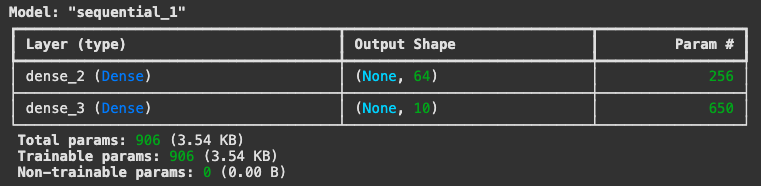
- 也可以為模型命名
model = keras.Sequential(name="my_sequential_model")
model.add(layers.Dense(64, activation="relu", name="hidden_layer"))
model.add(layers.Dense(10, activation="softmax", name="output_layer"))
model.build(input_shape=(None, 3))
model.summary()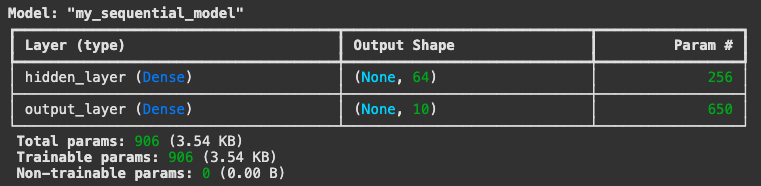
- 也可以提前宣告輸入的 shape
model = keras.Sequential()
model.add(keras.Input(shape=(3,)))
model.add(layers.Dense(64, activation="relu"))
model.summary()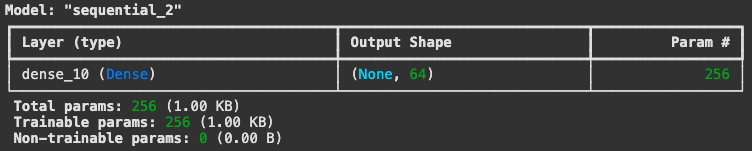
2. 函數式 API (Functional API)
- 序列式模型的應用範圍比較有限,因為只能建構一層接一層的模型,因此只能建構單一輸入與單一輸出的模型,但實際應用時,我們有可能會遇到多元輸入、多元輸出的情況,或是在模型內部建構,有非線性拓撲(topology)的需求。
inputs = keras.Input(shape=(3,), name="funtinoal_api")     # 實際上這一層並非一個神經層,只是用來建立模型輸入點的張量物件
features = layers.Dense(64, activation="relu")(inputs)
outputs = layers.Dense(10, activation="softmax")(features)
model = keras.Model(inputs=inputs, outputs=outputs)
model.summary()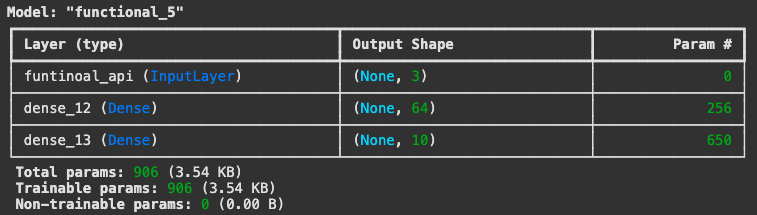
- 可以查看 layer 的 shape 與 dtype。
- 這樣的 layer 被稱為符號張量(symbolic tensor)
- 其中第 0 軸為 None,因為批次量為變數,其量不固定。第 1 軸需與單一樣本的維度相同。
print(inputs.shape)
print(inputs.dtype)
print(features.shape)
print(features.dtype)

> (None, 3)
> float32
> (None, 64)
> float32- 多輸入、多輸出的模型
news_size = 10000
tag_size = 20
department_size = 5

title = keras.Input(shape=(news_size,), name="title")
content = keras.Input(shape=(news_size,), name="content")
tags = keras.Input(shape=(tag_size,), name="tags")

features = layers.Concatenate()([title, content, tags])
features = layers.Dense(64, activation="relu")(features)

priority = (layers.Dense(1, activation="sigmoid", name="priority")(features))
department = (layers.Dense(department_size, activation="softmax", name="department")(features))

model = keras.Model(inputs=[title, content, tags], outputs=[priority, department])
flowchart TD
subgraph Inputs
T[title<br/>shape: 10000] --> C[Concatenate]
Co[content<br/>shape: 10000] --> C
Ta[tags<br/>shape: 20] --> C
end
subgraph Hidden
C --> D[Dense Layer<br/>units: 64<br/>activation: relu]
end
subgraph Outputs
D --> P[Priority Output<br/>Dense Layer<br/>units: 1<br/>activation: sigmoid]
D --> Dep[Department Output<br/>Dense Layer<br/>units: 5<br/>activation: softmax]
end
style T fill:#f9f,stroke:#333,stroke-width:2px
style Co fill:#f9f,stroke:#333,stroke-width:2px
style Ta fill:#f9f,stroke:#333,stroke-width:2px
style C fill:#bbf,stroke:#333,stroke-width:2px
style D fill:#bbf,stroke:#333,stroke-width:2px
style P fill:#bfb,stroke:#333,stroke-width:2px
style Dep fill:#bfb,stroke:#333,stroke-width:2px-
訓練多輸入、多輸出模型
- 按順序提供輸入、目標
import numpy as np n = 1280 title_data = np.random.randint(0, 2, size=(n, news_size)) content_data = np.random.randint(0, 2, size=(n, news_size)) tags_data = np.random.randint(0, 2, size=(n, tag_size)) priority_data = np.random.random(size=(n, 1)) department_data = np.random.randint(0, 2, size=(n, department_size)) model.compile(optimizer="rmsprop", loss=["mean_squared_error", "categorical_crossentropy"], metrics=[["mean_absolute_error"], ["accuracy"]]) model.fit([title_data, content_data, tags_data], [priority_data, department_data], epochs=1) model.evaluate([title_data, content_data, tags_data], [priority_data, department_data]) priority_preds, department_preds = model.predict([title_data, content_data, tags_data])- 使用字典輸入、目標
import numpy as np n = 1280 title_data = np.random.randint(0, 2, size=(n, news_size)) content_data = np.random.randint(0, 2, size=(n, news_size)) tags_data = np.random.randint(0, 2, size=(n, tag_size)) priority_data = np.random.random(size=(n, 1)) department_data = np.random.randint(0, 2, size=(n, department_size)) model.compile( optimizer='rmsprop', loss={ "priority": "mean_squared_error", "department": "categorical_crossentropy"}, metrics={ "priority": ["mean_absolute_error"], "department": ["accuracy"]}) model.fit({ "title": title_data, "content": content_data, "tags": tags_data }, { "priority": priority_data, "department": department_data }, epochs=1) model.evaluate({ "title": title_data, "content": content_data, "tags": tags_data }, { "priority": priority_data, "department": department_data }) priority_preds, department_preds = model.predict({ "title": title_data, "content": content_data, "tags": tags_data }) -
函數式 API 促成了兩個重要的功能:
- 模型視覺化(model visualization)
- 特徵萃取(feature extraction)
-
我們可以用
plot_model()來畫出模型的拓樸結構
from keras.utils import plot_model
plot_model(model, "news_classifier.png")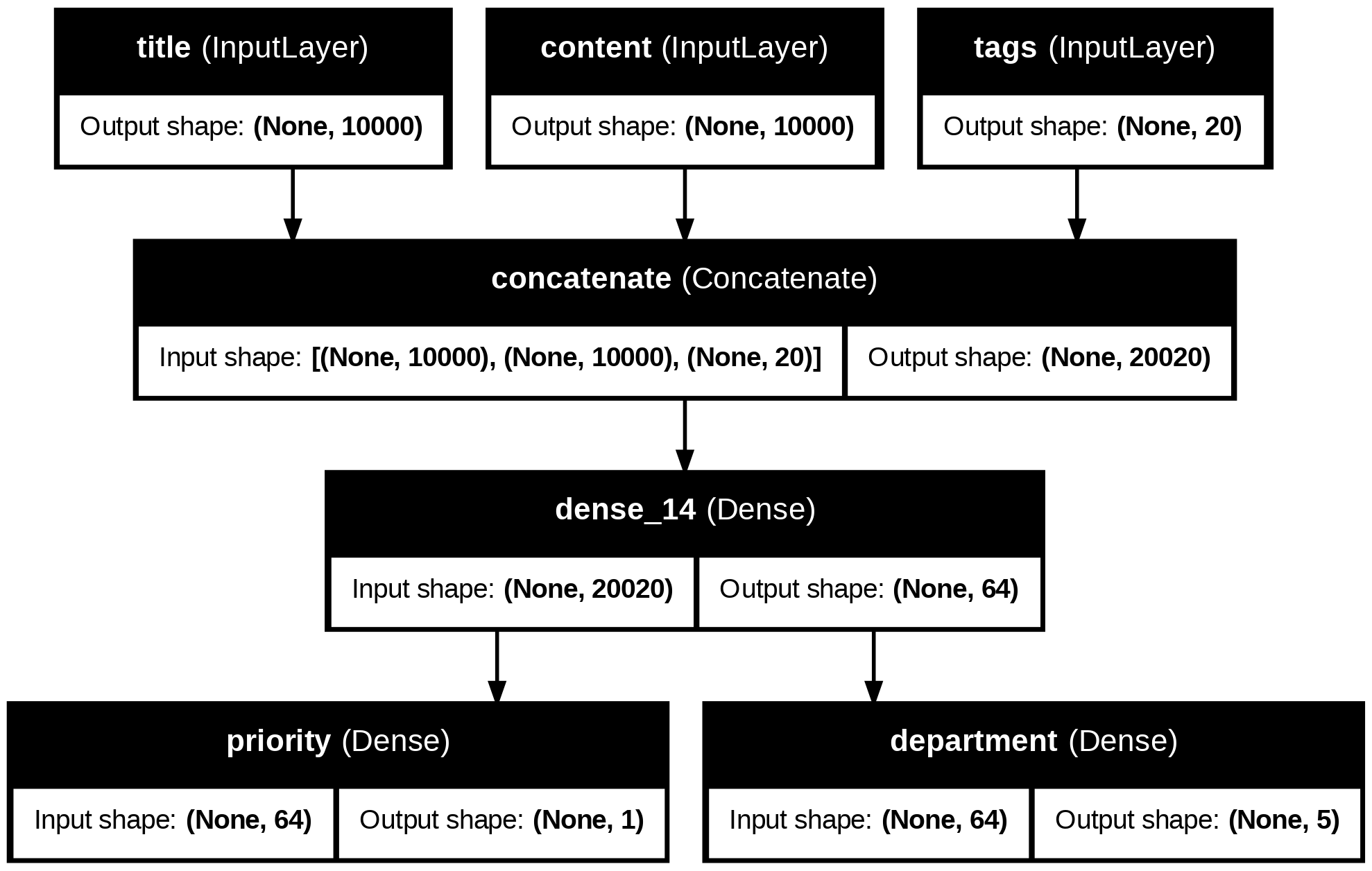
- 並且我們可以使用
model.layers來查看神經層的輸入與輸出的張量物件
model.layers

> [<InputLayer name=title, built=True>,
   <InputLayer name=content, built=True>,
   <InputLayer name=tags, built=True>,
   <Concatenate name=concatenate, built=True>,
   <Dense name=dense_14, built=True>,
   <Dense name=priority, built=True>,
<Dense name=department, built=True>]-
透過函數式 API,我們可以在既有的舊模型架構上,新增新的分支,有利於使用舊模型的中間特徵。
-
範例,在既有模型下,新增一個輸出 potential
features = model.layers[4].output
potential = layers.Dense(3, activation="softmax", name="potential")(features)
new_model = keras.Model([title, content, tags],
                        [priority, department, potential])
plot_model(new_model, "new_news_classifier.png", show_layer_names=True)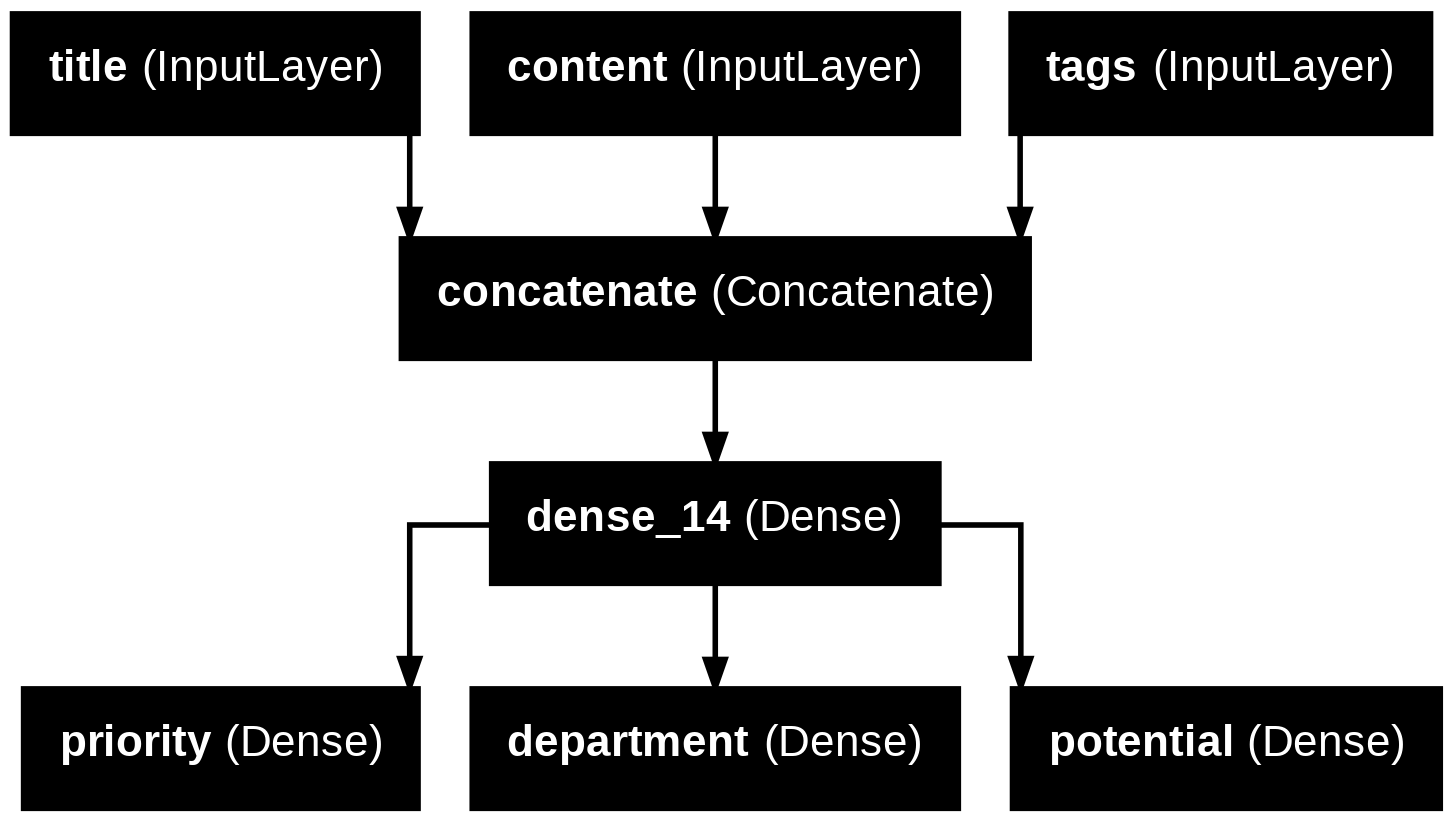
3. 繼承 Model 類別 (Subclassing the model class)
-
在
__init__()方法中,定義模型會用到的神經層。 -
在
call()方法中定義模型中的各神經層的定向傳播流程 -
實例化定義好的子類別
-
改寫先前的範範為 model 子類別
class NewsModel(keras.Model):
    def __init__(self, n):
        super().__init__()   # 要先呼叫父類別的初始化函式
        self.concat_layer = layers.Concatenate()
        self.mixing_layer = layers.Dense(64, activation='relu')
        self.priority_scorer = layers.Dense(1, activation='sigmoid')
        self.department_scorer = layers.Dense(n, activation='softmax')

    def call(self, inputs):  # 定義正向傳播的過程
        title = inputs["title"]
        content = inputs["content"]
        tags = inputs["tags"]
        features = self.concat_layer([title, content, tags])
        features = self.mixing_layer(features)
        priority = self.priority_scorer(features)
        department = self.department_scorer(features)
        return priority, department

model = NewsModel(n=5)
priority, department = model({
    "title": title_data,
    "content": content_data,
"tags": tags_data})- 進行編譯與訓練
model.compile(optimizer='rmsprop',
              loss=['mean_squared_error', 'categorical_crossentropy'],
              metrics=[['mean_absolute_error'], ['accuracy']])

model.fit({
    "title": title_data,
    "content": content_data,
    "tags": tags_data
}, [priority_data, department_data], epochs=1)

model.evaluate({
    "title": title_data,
    "content": content_data,
    "tags": tags_data
}, [priority_data, department_data])

priority_preds, department_preds = model.predict({
    "title": title_data,
    "content": content_data,
    "tags": tags_data
})-
Sequential 與 Functional 只能建構有向無環圖(acyclic graph)而在 subclassing 中則沒有限制,我們可以透過在
call()來設計流程,甚至可以用 for 迴圈 或是遞迴(recursion) 的方式來自由定義。 -
但使用 subclassing 也有缺點
- 無法使用
summary()與plot_model() - 無法取得神經層的圖節點進行特徵萃取
- 無法使用
Mixing
-
當然也可以搭配使用
- 含有 model 子類別的函數式模型
class Classifier(keras.Model): def __init__(self, n): super().__init__() if n == 2: units = 1 activation = 'sigmoid' else: units = n activation = 'softmax' self.dense = keras.layers.Dense(units, activation=activation) def call(self, inputs): return self.dense(inputs) inputs = keras.Input(shape=(3,)) features = layers.Dense(64, activation="relu")(inputs) outputs = Classifier(n=10)(features) model = keras.Model(inputs=inputs, outputs=outputs)- 包有函數式模型的 model 子類別
inputs = keras.Input(shape=(64,))
outputs = layers.Dense(1, activation='sigmoid')(inputs)
binary_classifier = keras.Model(inputs, outputs)

class MyModel(keras.Model):
		def __init__(self, n):
				super().__init__()
				self.dense = layers.Dense(64, activation='relu')
				self.classifier = binary_classifier

		def call(self, inputs):
				features = self.dense(inputs)
				return self.classifier(features)

model = MyModel(n=5)
設計評量指標
方均根誤差(root mean squared error, RMSE)
import tensorflow as tf

class RootMeanSquaredError(tf.keras.metrics.Metric):
    def __init__(self, name="rmse", **kwargs):
        super().__init__(name=name, **kwargs)
        self.mse_sum = self.add_weight(name="mse_sum", initializer="zeros")
        self.total_samples = self.add_weight(name="total_samples", initializer="zeros", dtype="int32")

    def update_state(self, y_true, y_pred, sample_weight=None):
        y_true = tf.one_hot(y_true, depth=tf.shape(y_pred)[1])
        mse = tf.reduce_sum(tf.square(y_true - y_pred))
        self.mse_sum.assign_add(mse)
        num_samples = tf.shape(y_pred)[0]
        self.total_samples.assign_add(num_samples)

    def result(self):
        rmse = tf.sqrt(self.mse_sum / tf.cast(self.total_samples, tf.float32))
        return rmse

    def reset_state(self):
        self.mse_sum.assign(0.)
        self.total_samples.assign(0)

model = get_mnist_model()
model.compile(optimizer="adam",
              loss="sparse_categorical_crossentropy",
              metrics=["accuracy", RootMeanSquaredError()])
model.fit(train_images, train_labels,
          epochs=3,
          validation_data=(val_images, val_labels))
test_metrics = model.evaluate(test_images, test_labels)
使用 callbacks 模組
- callback 時指在呼叫
fit()方法時可以傳遞給模型的一個物件,並可在訓練階段的各個時間點由模型所呼叫。 - 可以用於檢視模型狀態及表示,進而執行各類操作如中斷訓練、儲存模型、載入不同權重集合或更改模型狀態。
- 常見的 callback 模組有:
keras.callbacks.ModelCheckpointkeras.callbacks.EarlyStoppingkeras.callbacks.LearningRateSchedularkears.callbacks.ReduceLROnPlateaukeras.callbacks.CSVLogger
EarlyStopping + ModelCheckpoint
callbacks = [
    keras.callbacks.EarlyStopping(
        monitor="val_accuracy",   #監控模型的驗證準確度
        patience=2,   # 超過兩個週期沒有改善就停止
    ),
    keras.callbacks.ModelCheckpoint(       # 在每個週期結束後儲存模型
        filepath="checkpoint_path.keras",  # 存檔路徑及檔名
        monitor="val_loss",
        save_best_only=True,               # 當 val_loss 有改善時才儲存模型
    )
]

model = get_mnist_model()
model.compile(optimizer="adam",
              loss="sparse_categorical_crossentropy",
              metrics=["accuracy"])   # 對應到監控
model.fit(train_images, train_labels,
          epochs=10,
          callbacks=callbacks,       # 在 training 時加入 callbacks
          validation_data=(val_images, val_labels))  # 一定要加入驗證集
設計 custom callback
- 有以下的呼叫時間點的方法可以自定義:
on_epoch_begin(epoch, logs)# 在每個訓練週期的開始時呼叫on_epoch_end(epoch, logs)# 在每個訓練週期的結束時呼叫on_batch_begin(batch, logs)# 在處理每個批次資料前呼叫on_batch_end(batch, logs)# 在處理每個批次資料後呼叫on_train_begin(logs)# 在訓練開始時呼叫on_train_end(logs)# 在訓練結果時呼叫
from matplotlib import pyplot as plt

class LossHistory(keras.callbacks.Callback):
	def on_train_begin(self, logs):
		self.per_batch_losses = []

	def on_batch_end(self, batch, logs):
		self.per_batch_losses.append(logs.get('loss'))

	def on_epoch_end(self, epoch, logs):
		plt.clf()
		plt.plot(range(len(self.per_batch_losses)),
			self.per_batch_losses,
			label='Training loss for each batch')
		plt.xlabel(f'Batch (epoch {epoch})')
		plt.ylabel("Loss")
		plt.legend()
		plt.savefig(f"plot_at_epoch_{epoch}")
		self.per_batch_losses = []

model = get_mnist_model()
model.compile(optimizer="adam",
              loss="sparse_categorical_crossentropy",
              metrics=["accuracy"])
model.fit(train_images, train_labels,
          epochs=10,
          callbacks=[LossHistory()],
          validation_data=(val_images, val_labels))
使用 TensorBoard
- TensorBoard 是一個以瀏覽器為基礎的視覺化工具,可以在本地端運行。可以用來在訓練進行時,監控模型內部變化的最佳方法。
- 使用的方法是在
fit()中引入keras.callbacks.TensorBoard。
model = get_mnist_model()
model.compile(optimizer="adam",
              loss="sparse_categorical_crossentropy",
              metrics=["accuracy"])
tensorboard = keras.callbacks.TensorBoard(
    log_dir="/tensor_board_log"  # 定記錄檔案的寫入位置
)
model.fit(train_images, train_labels,
          epochs=10,
          validation_data=(val_images, val_labels),
callbacks=[tensorboard])- 接著輸入以下指令開啟 TensorBoard 介面
%load_ext tensorboard
%tensorboard --logdir /tensor_board_log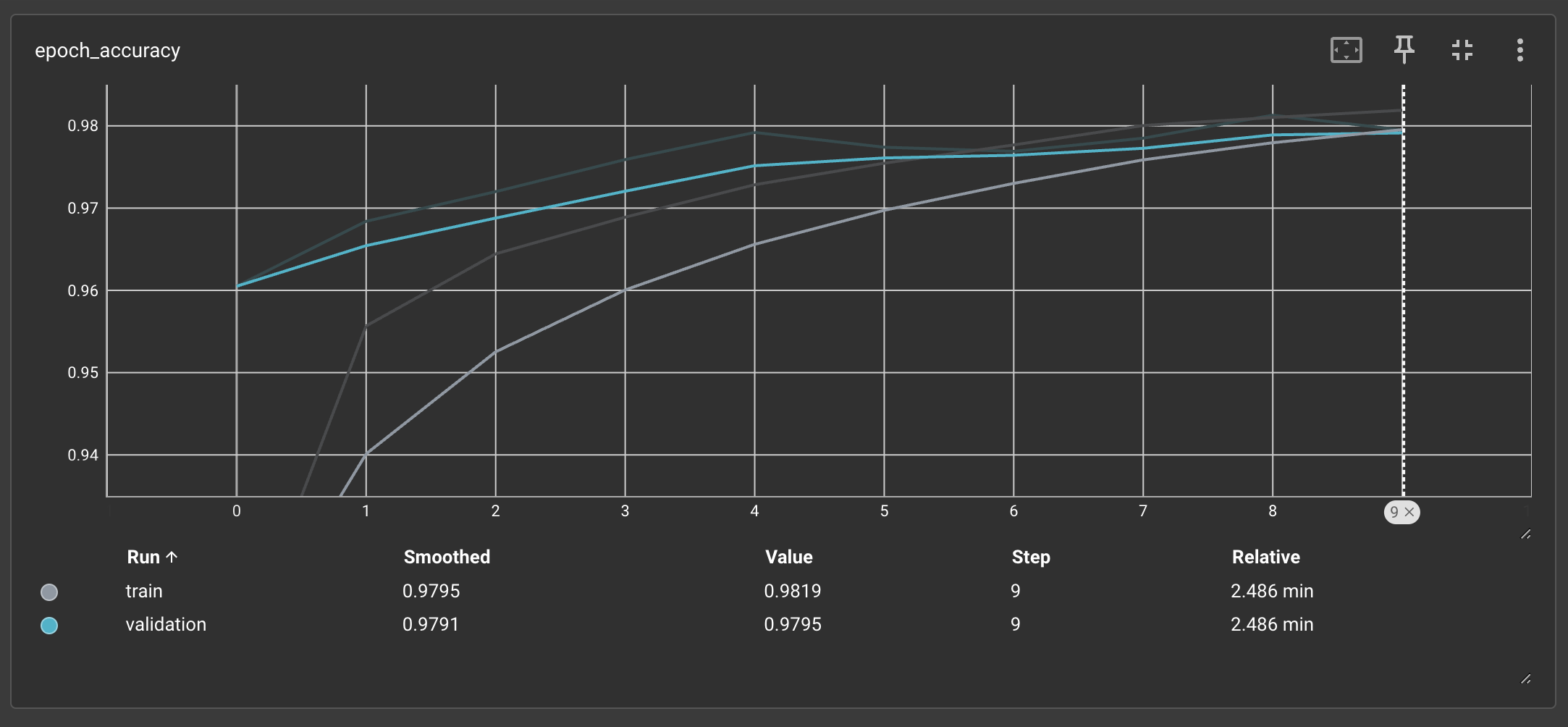
實作演練
- 重心在實作一次 mnist
from tensorflow import keras
from tensorflow.keras import layers
from tensorflow.keras.datasets import mnist

def get_mnist_model():
    inputs = keras.Input(shape=(28 * 28,))
    features = layers.Dense(512, activation="relu")(inputs)
    features = layers.Dropout(0.5)(features)
    outputs = layers.Dense(10, activation="softmax")(features)
    model = keras.Model(inputs=inputs, outputs=outputs)
    return model

(images, labels), (test_images, test_labels) = mnist.load_data()
images = images.reshape((60000, 28 * 28)).astype("float32") / 255
test_images = test_images.reshape((10000, 28 * 28)).astype("float32") / 255
train_images, val_images = images[10000:], images[:10000]
train_labels, val_labels = labels[10000:], labels[:10000]

model = get_mnist_model()
model.compile(optimizer="adam",
              loss="sparse_categorical_crossentropy",
              metrics=["accuracy"])
model.fit(train_images, train_labels, epochs=3,
          validation_data=(val_images, val_labels))
test_metrics = model.evaluate(test_images, test_labels)
predictions = model.predict(test_images)
print(test_metrics)