- 要達到完美擬合(perfect fit),勢必要先經歷過度擬合(overfitting),否則我們無法預先知道邊界在哪裡。
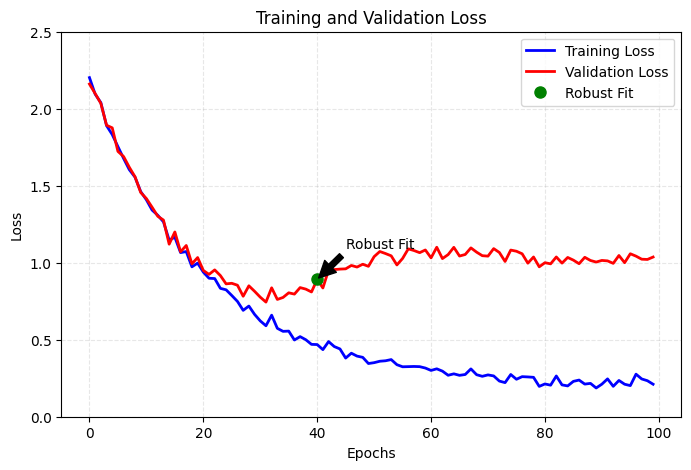
- 因此我們要處理任何機器學習問題的初始目標,便是訓練出一個能展現基本普適化能力,並且會發生 overfitting 的模型,接著才可以專注在解決 overfitting 並提升模型的普適化能力。
- 我們會遇到三個 status:
- 訓練沒有成效,損失值降不下來。
- 訓練可行,但無法展現普適化,無法超越基準線。
- 訓練可行且表現也超越基準線,但無法達到 overfitting。
調整梯度下降的關鍵參數
- 當訓練沒有成效,代表損失無法下降。
- 一般而言,就算資料是隨機的,模型有辦法擬合,所以損失無法下降通常可以斷定是 gradient descent 的參數設置需要調整,包含:
- 優化器(optimizer)
- 初始權重(initial weight)
- 學習率(learning rate)
- 批次量(batch size)
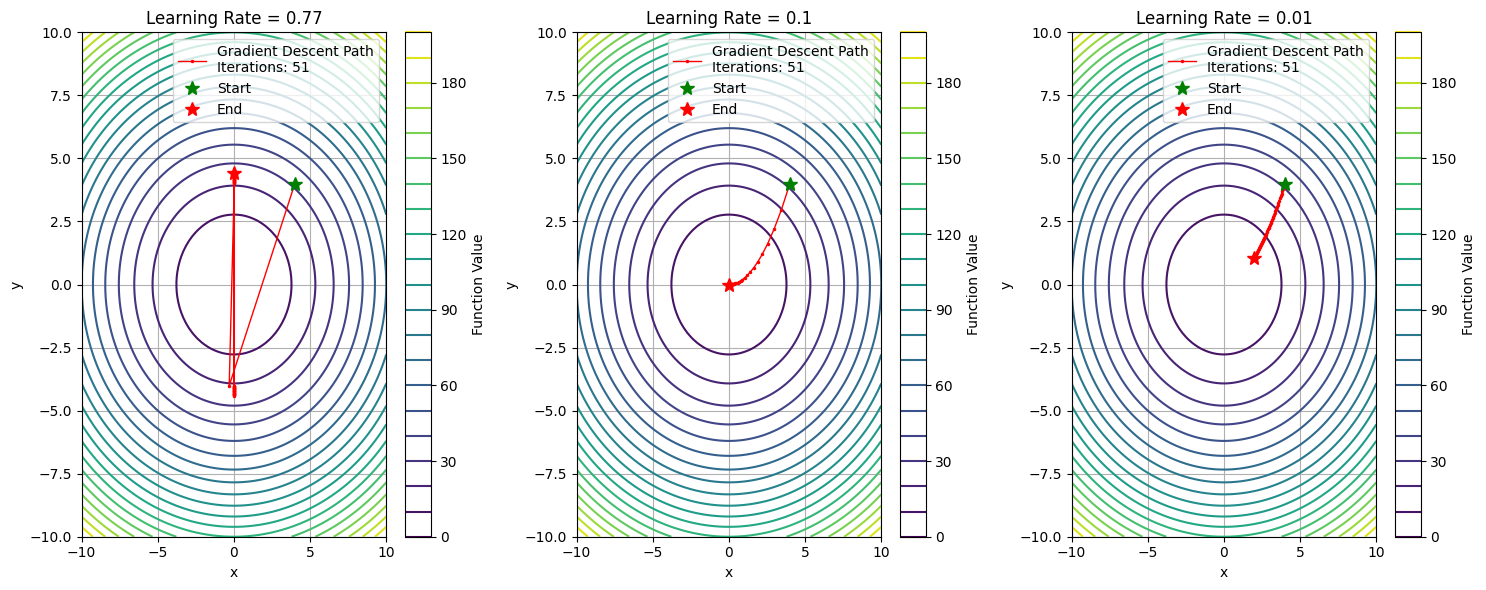
- 從上圖可見,當學習率太大時,每一次的跨幅過大,使 loss 無法降低;當學習率太小時,每次跨幅太小,訓練的效率不好,當學習率適當時,可以達到最好的成效。
學習率比較的程式碼
import numpy as np
import matplotlib.pyplot as plt

def objective_function(x, y):
    return 0.7*x**2 + 1.3*y**2

def gradient(x, y):
    return np.array([1.4*x, 2.6*y])

def gradient_descent(learning_rate, start_point, n_iterations=50):
    path = [start_point]
    point = np.array(start_point)

    for _ in range(n_iterations):
        grad = gradient(point[0], point[1])
        point = point - learning_rate * grad
        path.append(point.copy())

        if np.linalg.norm(grad) < 1e-6:
            break

    return np.array(path)

x = np.linspace(-10, 10, 100)  # 擴大範圍到 ±10
y = np.linspace(-10, 10, 100)
X, Y = np.meshgrid(x, y)
Z = objective_function(X, Y)

plt.figure(figsize=(15, 6))

learning_rates = [0.77, 0.1, 0.01]
titles = ['Learning Rate = 0.77', 'Learning Rate = 0.1', 'Learning Rate = 0.01']
start_point = np.array([4.0, 4.0])

for i, (lr, title) in enumerate(zip(learning_rates, titles)):
    plt.subplot(1, 3, i+1)

    plt.contour(X, Y, Z, levels=20, cmap='viridis')

    path = gradient_descent(lr, start_point)
    plt.plot(path[:, 0], path[:, 1], 'r.-', linewidth=1, markersize=3,
             label=f'Gradient Descent Path\nIterations: {len(path)}')

    plt.plot(path[0, 0], path[0, 1], 'g*', markersize=10, label='Start')
    plt.plot(path[-1, 0], path[-1, 1], 'r*', markersize=10, label='End')

    plt.title(title)
    plt.xlabel('x')
    plt.ylabel('y')
    plt.legend()
    plt.colorbar(label='Function Value')
    plt.grid(True)

plt.tight_layout()
plt.show()
使用不同的架構
- 選擇合適的模型架構處理不同類型的問題
- DNN
- CNN(Convolutional Neural Networks)
- RNN(Recurrent Neural Networks)
- Transformer
- Autoencoders
- GAN(Generative Adversarial Networks)
- GNN(Graph Neural Networks)
- …
提升模型容量(capacity)
- 如果損失值的確有降低,代表模型的確有在擬合資料,但始終無終達到 overfitting,那可能是模型的 表徵能力(representational power) 不足。
- 這時可能需要更大的模型,以容納更多的資訊,
- 可以透過加深、加寬 layer 來提升模型的容量。
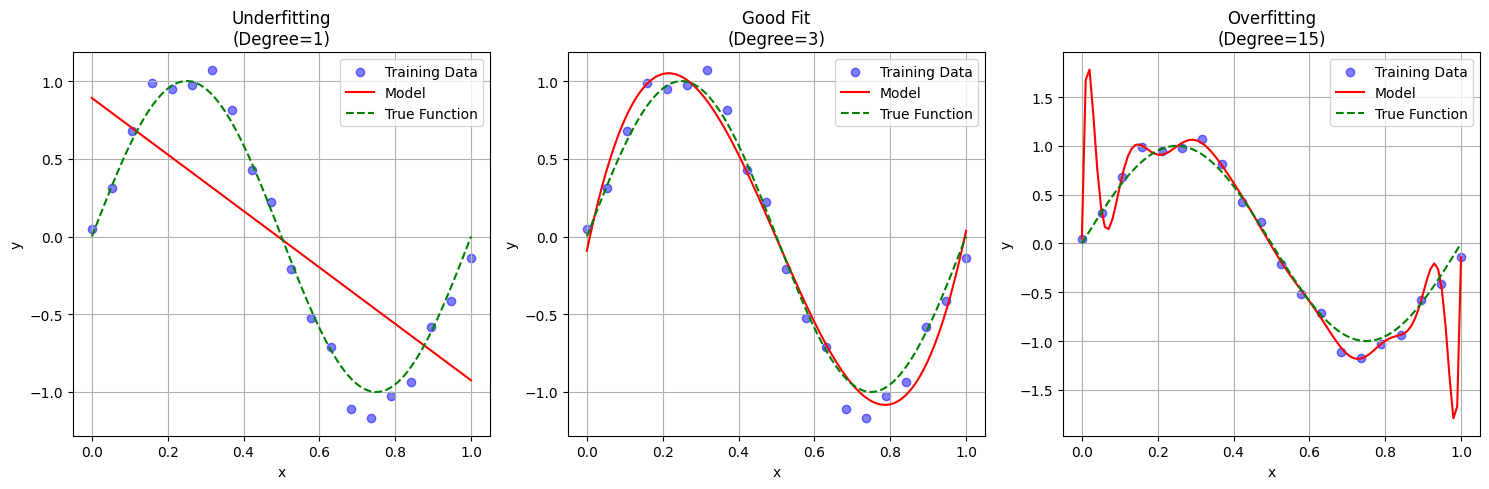
- 從上例,用一個 sin 函數做為 target function,然後用不同 degree 的方程式來進行擬合。當 degree = 1 時,這個線性模型不管怎麼樣都無法 fit data,說明它的模型沒有足夠的表徵能力,而當 degree = 15 時,模型過份的去 fit data,當今天有新的 data 加入時,模型就會無法很好的預測,這代表模型缺乏普適力。
用 n 次方程式來說明模型容量的差異程式碼
import numpy as np
import matplotlib.pyplot as plt
from sklearn.preprocessing import PolynomialFeatures
from sklearn.linear_model import LinearRegression

# 生成數據
np.random.seed(42)
X = np.linspace(0, 1, 20).reshape(-1, 1)
y_true = np.sin(2 * np.pi * X)
y = y_true + np.random.normal(0, 0.1, X.shape)

# 訓練不同容量的模型
degrees = [1, 3, 15]
X_test = np.linspace(0, 1, 100).reshape(-1, 1)

plt.figure(figsize=(15, 5))
titles = ['Underfitting\n(Degree=1)', 'Good Fit\n(Degree=3)', 'Overfitting\n(Degree=15)']

for i, degree in enumerate(degrees):
    plt.subplot(1, 3, i+1)

    # 轉換特徵
    poly = PolynomialFeatures(degree)
    X_poly = poly.fit_transform(X)
    X_test_poly = poly.transform(X_test)

    # 訓練模型
    model = LinearRegression()
    model.fit(X_poly, y)
    y_pred = model.predict(X_test_poly)

    # 繪圖
    plt.scatter(X, y, color='blue', alpha=0.5, label='Training Data')
    plt.plot(X_test, y_pred, 'r-', label=f'Model')
    plt.plot(X_test, np.sin(2 * np.pi * X_test), 'g--', label='True Function')

    plt.title(titles[i])
    plt.xlabel('x')
    plt.ylabel('y')
    plt.legend()
    plt.grid(True)

plt.tight_layout()
plt.show()